College Golf · 5 min read · Updated September 13, 2026
College Golf Scholarships and Money: Equivalencies, Roster Limits, and What Families Actually Pay
Fewer than one in ten college golfers is on a full athletic scholarship. That is not a discouraging statistic; it is the key to understanding how the money works, and why academic aid usually matters more than the golf offer.
Golf is an equivalency sport
In "head-count" sports like football and basketball, a scholarship is a scholarship. Golf is an equivalency sport: each program has a pool of scholarship money, expressed as a number of full-scholarship equivalents, and the coach divides it across the roster however they like. A D1 men's coach with 4.5 equivalencies and nine players might give one player a full ride, three players 75 percent, and the rest 25 percent or nothing. Two players on the same team can be paying wildly different amounts.
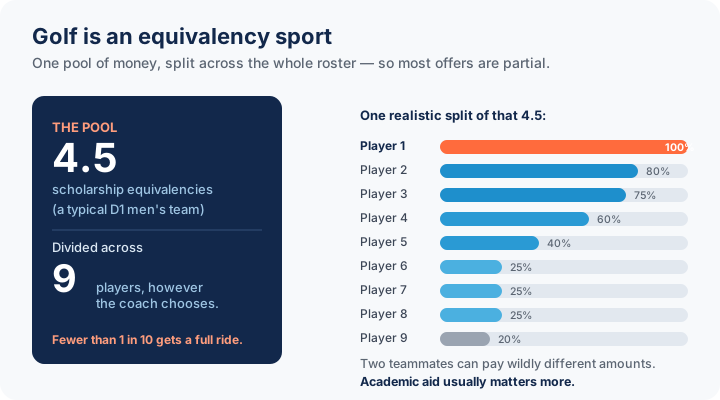
Consequences:
- Most offers are partial. "A scholarship" often means 30 to 60 percent of cost of attendance.
- Offers are renewed annually and can change (up or down) based on performance and roster needs.
- Coaches spend money where they have a gap. A team losing three seniors has money; a team with a full roster of underclassmen does not, however good you are.
What changed in 2025
The House v. NCAA settlement, approved in June 2025, reshaped the rules for Division I schools that opted in (the large majority of D1):
- Roster limits replace scholarship caps. Golf's limit is nine players per team. Schools may fund up to nine scholarships, versus the old 4.5 men's / 6 women's caps.
- In practice, funding rose modestly. A few power-conference programs now fund more; many kept the old amounts. Ask each coach directly how many equivalencies they fund.
- Rosters shrank. Teams that carried 12 or 14 players cut to nine. Walk-on spots at opting-in schools nearly vanished, and some cut players were grandfathered as "designated student-athletes" who do not count against the limit.
- Revenue sharing. Opting-in schools can share up to roughly $20 million a year with athletes, but almost all of it goes to football and basketball. Golfers at a handful of schools receive small amounts.
- Everyone else is unchanged. D1 schools that did not opt in keep the 4.5 / 6 caps with no roster limit, and D2, D3, NAIA, and NJCAA are not parties to the settlement: their scholarship and roster rules did not change.
The bottom line for a family: the D1 market is slightly more generous for the top of the recruiting class and tighter for everyone else, which pushes more good players to D2, D3, and NAIA, where the golf is excellent and the money is often better.
The money that actually pays for college
For most college golfers, the biggest number on the aid letter is not the golf scholarship.
- Academic merit aid is awarded by the university, not the coach, and often ranges from $5,000 to $30,000 a year at private schools. It stacks with athletic aid and does not count against the coach's pool. A 3.8 GPA with a strong test score is worth more than two strokes.
- Need-based aid at selective D3 and D1 schools can cover the full cost for families under certain income levels.
- In-state tuition at a public D1 or D2 with a 40 percent golf scholarship can cost less than a 70 percent scholarship at a private school.
- NJCAA scholarships plus low tuition can make two years of college essentially free, then a transfer scholarship for the last two.
Ask every coach the same question: "What is the total cost of attendance after all aid, athletic and academic?" Compare that number, not the scholarship percentage.
NIL for college golfers
Name, image, and likeness money exists in golf but is small outside the top 25 or so players in the country. Golfers at most schools may sign equipment or local deals worth a few hundred to a few thousand dollars. Do not choose a school for NIL unless you are a top-ranked recruit with a concrete offer in writing.
What a college golfer's year costs beyond tuition
Programs cover travel, hotels, and meals at tournaments and usually provide clubs, balls, and apparel through equipment deals. Families still pay for summer competition (the amateur events coaches expect players to play), lessons if the player uses an outside coach, and often a car. Budget $3,000 to $8,000 a year for summer golf at the D1 level.
Evaluating an offer
Get every offer in writing (the National Letter of Intent program ended in 2024; schools now use written offers and financial aid agreements). Then ask:
- What is the total cost after all aid, per year, and what would change it? Renewal terms and GPA requirements matter.
- How many players are on the roster, and how many travel? Nine on the roster and five traveling means four players sit every week.
- Where would I qualify? Ask the coach honestly where you would rank on the current roster and who is graduating.
- What happens if the coach leaves? The scholarship belongs to the school, but the roster spot belongs to the next coach.
- What is the academic fit? The degree is what you keep.
A partial scholarship at the school where you will play every week beats a bigger scholarship where you will not.
For international players
Athletic and academic aid rules are the same, but need-based aid is rarely available to non-US citizens, and the NCAA amateurism rules and visa process add steps. Start with the international recruiting guide.
Scholarships you apply for directly
Athletic scholarships from a coach are only one source of money. Caddie scholarships (the Evans and Ouimet are full or near-full rides), junior-tour and foundation awards, need-based funds, women-in-golf scholarships, and golf-industry-career awards are all separate programs you apply to yourself — and they stack on top of athletic and academic aid. Our junior golf scholarship directory lists real national and regional programs, each linked to its official application, with eligibility, award, and deadlines.
Next: how to find the programs where the money is, and the recruiting timeline.
Written by the Junior Golf America editorial team at AmateurGolf.com. Costs, rules, and tour policies change; confirm specifics with each organizer before entering.