College Golf · 5 min read · Updated September 13, 2026
College Golf Divisions Explained: NCAA D1, D2, D3, NAIA, NJCAA, and Club Golf
"College golf" means six very different things. The top of NCAA Division I is professional-grade golf with full scholarships and charter flights. The bottom of Division III is a team that plays six tournaments a year and whose best player shoots 80. Both are college golf, both give a player four more years of competitive golf and a team, and there is room for far more players than most families assume.
The levels
NCAA Division I
About 295 men's and 270 women's programs, from the power conferences to small schools whose entire athletic budget would not cover a football team's travel. Two seasons (fall and spring), 10 to 14 tournaments of 54 holes, six regionals in May feeding a national championship that ends in match play.
Money. Before 2025, D1 men's golf was capped at 4.5 scholarship equivalencies and women's at 6, split across the roster. Under the House settlement, schools that opt in now face a roster limit of nine and may fund up to nine scholarships if they choose. Most do not fund the maximum; many fund the same 4.5 or 6 they always did, and some power-conference programs now offer more. Non-opting schools keep the old caps.
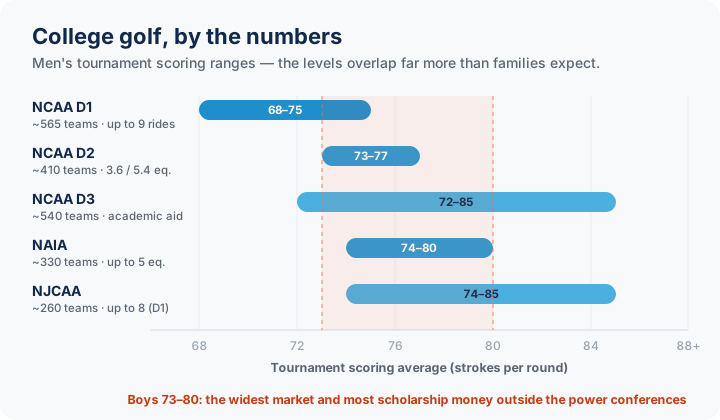
Scoring. Top-50 programs: men 68–72, women 69–74 in tournaments. Mid- and low-major programs: men 72–75, women 74–78. Most D1 scholarships and most D1 rosters are in the second group.
NCAA Division II
About 215 men's and 195 women's programs. Same fall/spring structure, slightly shorter schedules, regional championships in May and a national championship in match play. 3.6 men's / 5.4 women's scholarship equivalencies, unchanged by the House settlement, and no roster limit. Strong D2 teams beat mid-major D1 teams regularly. Scoring: men 73–77, women 76–82.
NCAA Division III
About 300 men's and 240 women's programs, the largest group in college golf. No athletic scholarships, but academic and need-based aid can be substantial, and top D3 programs (many at highly selective schools) play D1-quality golf. Schedules are shorter, seasons are the same, and the national championship is 72 holes of stroke play. No roster limit. Scoring ranges from men 72 at the top to 85+ on developing rosters; women from 76 to 95+.
NAIA
About 175 men's and 155 women's programs at smaller colleges. Up to 5 scholarship equivalencies for each; rosters are often 8 to 12. Eligibility runs through the NAIA Eligibility Center, not the NCAA. Top NAIA programs are as strong as good D2 teams; the depth of the division reaches into the 80s. NAIA recruiting rules are far looser: coaches can contact players at any age.
NJCAA (junior college)
About 160 men's and 100 women's programs in three divisions. NJCAA Division I allows up to 8 full scholarships, Division II tuition-and-fees only, Division III none. Two years, then a transfer to a four-year school with two or three years of eligibility left. The best NJCAA players are D1 recruits who needed grades, time, or a second look; the depth of the division reaches into the mid-80s. Our junior college guide covers the route in detail.
NCCGA club golf
The National Collegiate Club Golf Association has more than 350 club teams. They play regional tournaments each semester (usually 36 holes over a weekend) and a national championship. Any student can join; teams often have an "A" side for players who shoot in the 70s and a "B" side for everyone else. Costs are dues and travel, usually a few hundred dollars a semester. For a player who wants competitive golf and a team without the time commitment or the recruiting process, this is often the best fit.
Side by side
| Level | Programs (M / W) | Athletic aid | Roster | Men's scoring | Women's scoring |
|---|---|---|---|---|---|
| NCAA D1 | ~295 / ~270 | Up to 9 (opt-in) or 4.5 / 6 | 9 (opt-in) | 68–75 | 69–78 |
| NCAA D2 | ~215 / ~195 | 3.6 / 5.4 | No limit | 73–77 | 76–82 |
| NCAA D3 | ~300 / ~240 | None (academic aid only) | No limit | 72–85 | 76–95 |
| NAIA | ~175 / ~155 | Up to 5 | No limit | 74–80 | 78–88 |
| NJCAA | ~160 / ~100 | Up to 8 (D1), tuition (D2), none (D3) | No limit | 74–85 | 80–95 |
| NCCGA club | 350+ teams | None | Open | Any | Any |
Program counts are approximate and change every year; the college golf hub shows the latest figures we have checked and links to each governing body's directory.
Where each player fits
- Top-100 ranked juniors target D1, and the choice is about fit, not level.
- Boys averaging 73–76 and girls 75–80 in real tournaments have a wide market: mid-major D1, top D2, top D3, and top NAIA. This is where most scholarship money outside the power conferences is spent, and where recruiting emails matter most, because coaches at these schools cannot see every tournament.
- Boys 76–80 and girls 80–88 are recruitable at hundreds of D2, D3, NAIA, and NJCAA programs. Academic profile is often the deciding factor.
- Anyone who can post a score can play club golf.
Use the scoring calibrator for a quick read, then the recruiting timeline for what to do about it.
Three things families get wrong about divisions
- Higher division is not better golf for your player. A D3 player who travels to every event develops more than a D1 player who never makes the five.
- D3 "no scholarships" is not "no money." Selective D3 schools routinely meet full financial need, and merit aid at many D3s exceeds a partial golf scholarship at a D1.
- The transfer portal moves in both directions. Players go D1 to D2 for playing time as often as the reverse. Nothing is permanent.
Next: how scholarships and money really work, and how to find programs that fit.
Written by the Junior Golf America editorial team at AmateurGolf.com. Costs, rules, and tour policies change; confirm specifics with each organizer before entering.